
Hawa Mahal: The Palace of Winds
Located on the edge of the City Palace complex, overlooking the bustling Johari Bazaar, Hawa Mahal is one of Jaipur's most iconic historical monuments.
Also known as the "Palace of Winds" or "Palace of Breeze", the five-storey structure is famous for its numerous small windows, known as jharokhas, which allow natural air to circulate throughout the building.
Hawa Mahal was built in 1799 by Maharaja Sawai Pratap Singh, the grandson of Maharaja Sawai Jai Singh II and ruler of Jaipur at the time.
The palace was designed by architect Lal Chand Ustad as an extension of the royal women's quarters.
Its architectural design allowed the royal women to observe street life, festivals and ceremonial processions without being seen by people outside.
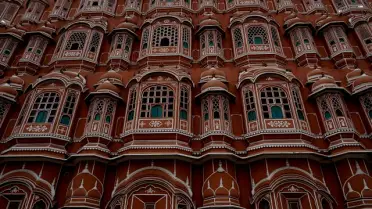
Impressive Architecture: The exterior of Hawa Mahal is particularly admired for its elaborate façade, decorative balconies, carved sandstone details and intricate latticework.
In contrast, the interior is comparatively simple, featuring corridors, chambers, courtyards and passages.
This contrast between the richly decorated exterior and relatively understated interior makes the palace architecturally distinctive.
Hawa Mahal is a familiar landmark of Jaipur's historic walled city.
Its unique design, cultural significance and location beside the traditional markets make it an important attraction for visitors exploring the heritage of Rajasthan.
Unlike many conventional palaces, much of Hawa Mahal's visual appeal comes from its elaborate street-facing façade.
The numerous windows and projecting balconies create a distinctive honeycomb appearance, while the inner sections contain relatively simple rooms and corridors that connect the different levels of the building.
Hawa Mahal Structure and Purpose
Hawa Mahal is a five-storey structure rising approximately 50 feet (15 metres) above the ground.
Its most distinctive feature is its façade, which contains 953 small windows and niches known as jharokhas, decorated with intricate latticework.
These windows give the palace its characteristic honeycomb-like appearance.
Latticework is a decorative open framework made by arranging intersecting strips or patterns of material to create a series of small openings.
At Hawa Mahal, the intricately carved stone screens serve both decorative and practical purposes, allowing air to flow through the building while providing privacy to those inside.
The palace features a distinctive pyramidal design, with its upper floors arranged in a gradually narrowing structure.
Its curved façade, projecting balconies, domes and decorative sandstone details contribute to its unusual architectural appearance.
The front elevation, as viewed from the street, resembles a honeycomb with numerous small windows, carved sandstone screens, miniature domes and decorative finials.
The semi-octagonal projections and finely detailed latticework give the monument its distinctive façade, making it one of the most recognisable architectural landmarks in India.
The inner section of the palace is comparatively less ornate and consists of chambers, pillars, courtyards and connecting corridors.
The different floors feature traditional architectural elements and offer views of Jaipur's historic streets and surrounding monuments.
The primary purpose of Hawa Mahal was to provide the royal women with a private view of everyday street life, religious celebrations and royal processions.
The small latticed windows allowed them to observe activities in Johari Bazaar and the surrounding streets without being seen by people outside, in keeping with the purdah customs followed by the royal household at the time.
Famous for its beehive-like structure, Hawa Mahal is an impressive example of the use of red and pink sandstone in traditional Rajasthani architecture.
Its carefully designed windows, decorative screens and white ornamental details complement the distinctive pink façade.
Today, this historic monument stands as a symbol of Jaipur's royal heritage and continues to attract visitors from India and around the world.
Pink City Jaipur
Jaipur, the capital and largest city of Rajasthan, is popularly known as the Pink City.
The city earned this name in 1876 when Maharaja Sawai Ram Singh II ordered the old city painted in a distinctive pink colour to welcome the Prince of Wales, who later became King Edward VII.
The tradition of maintaining the pink appearance of the historic walled city has continued over the years.
Located approximately 280 kilometres from Delhi, Jaipur is one of Rajasthan's most popular tourist destinations.
Surrounded by magnificent forts, royal palaces, heritage hotels and traditional markets, the Pink City is an essential destination on many travellers' itineraries.
Its rich history, vibrant culture, traditional handicrafts and architectural landmarks make Jaipur an important part of India's tourism heritage.
Jaipur is also a well-known destination for shopping, traditional handicrafts, jewellery, textiles and Rajasthani artwork.
Among its most recognisable landmarks is the magnificent Hawa Mahal, popularly known as the "Palace of Winds".
Its distinctive pink sandstone façade and honeycomb-like arrangement of windows have made it one of the most photographed monuments in Rajasthan.
Hawa Mahal Jaipur | Palace of Winds | Hawa Mahal Was Built by Sawai Pratap Singh | about hawa mahal | Palace of Winds Built for Royal Women | Pink City Jaipur.More in Travel
Mysore Palace Karnataka | Mysore Palace History.
Mysore Palace Karnataka | About Mysore Palace | Mysore Palace History.
2021-08-02
travelDo you need travel insurance for jersey Channel Islands?
Travel insurance for jersey Channel Islands | what is travel insurance? | flight insurance and trip insurance, do you need one?
2025-04-27
travelHistory of Taj Mahal, Agra | The Taj all you need to know.
History of Taj Mahal, why Taj Mahal was built. The Taj all you need to know.
2021-08-01
travelRed Fort Delhi | Why Red Fort was built? | red fort Lal Qila
Why Red Fort was built? | Lal Qila | red fort history | Red Fort Delhi India.
2021-07-31
travelGol Gumbaz | Gol Gumbaz built by Mohammed Adil Shah, sultan
Gol Gumbaz – Built by Mohammed Adil Shah | The “Taj of the South”
2026-04-10
travelJodhpur tourist attractions | tourist places nearby Jodhpur.
Jodhpur tourist attractions | tourist places nearby Jodhpur | Jodhpur Rajasthan.
2022-08-25
travelIndia Population 2026 | India vs China Population
India Population 2026: World's Most Populous Country | Trends & China Comparison
2024-05-03
travelPopular Indian vegetarian dishes | popular Indian dishes.
Popular Indian vegetarian dishes | popular Indian dishes - Dosa, Shahi Paneer, Vegetable Biryani.
2023-08-07
travelGlasgow Subway | Glasgow Metro | glasgow subway map.
Glasgow Subway | Glasgow subway stations | How old is glasgow subway?
2024-08-18
travelMeraas City Walk Dubai | luxury residential | Property price
Meraas City Walk Dubai | City Walk Dubai.
2024-09-23
travelAin Dubai reopening soon? Enhancement work closure?
Ain Dubai reopening | Ain Dubai Enhancement work closure | Ain Dubai status?
2024-10-30
travelSpirit Airlines files for bankruptcy.
2024-11-18
travelAverage cost of living in India's top 10 cities.
Average cost of living in India's top 10 cities | Mumbai living cost and rents.
2024-12-02
travelRas Al Khaimah property | al marjan island | Properties in r
Ras Al Khaimah property | al marjan island | Properties in rak.
2024-12-07
travelthe line, NEOM | Saudi Arabia the line city update
The line project update, NEOM, Saudi Arabia | The line saudi arabia | Saudi Arabia Vision 2030 | The Line NEOM.
2024-12-24
travelDamac Properties | Affordable option, Damac Hills two | Dama
Damac Properties | Damac Hills two | Safa Gate | Damac apartment price | Damac vs Emaar.
2025-03-07
travelworld rivers | top rivers | longest river | World's top rive
World's top rivers | top 20 rivers list | longest rivers- nile, amazon, mississippi, yellow river | longest river in Asia.
2025-04-11
travelDo you need travel insurance for jersey Channel Islands?
Travel insurance for jersey Channel Islands | what is travel insurance? | flight insurance and trip insurance, do you need one?
2025-04-27
travelTallest observation wheel- Ain Dubai | Dubai eye
World’s tallest observation wheel, Ain Dubai (Dubai Eye) all you need to know.
2025-07-22
travelAjman One Phase 2 | Aqaar Developer | flat price 316,000 AED
Ajman One Phase 2, Aqaar Developer flat price starts at 316,000 AED | Ajman real estate;
2025-08-02
travelExplore Dedaandsons
Discover more free tools, services and features.
Editorial Guidelines
Learn how Dedaandsons researches, updates and publishes news, articles and educational content.
Connect with Dedaandsons
Support Dedaandsons
Help us keep our articles, tools and services free for everyone.
Work with Dedaandsons
Advertising, partnerships, guest articles and business enquiries.
Contact Us →